Showing posts with label Debate. Show all posts

Tuesday, 13 May 2014

Small Changes in Big Business

Can fashion ever be ethical?

And more to the point; can fast fashion ever be ethical?

This point is discussed and debated in the world of ethical fashion on a regular basis. When I first came across the ethical fashion industry I think I was maybe a little too idealistic about the ethical labeling organisations and maybe a little too critical of the fast fashion industry. Either that or just maybe the fast fashion industry is improving. 

I think it's probably a bit of both but either way, I feel like I need to state the case for the fashion industry that in the past I may have judged rather harshly.

The high street has come a long way since I first became acquainted with corporate social responsibility and ethical trade. In the beginning I cast my judgment upon the high street indiscriminately, failing to take notice of those brands that were seeking to change. To be fair, the brands that choose to seek more ethical ways of trading are not always the ones who shout about it. If we take a look at brands like ASOS and New Look, you might not immediately think of them as very 'green' companies but both are going above and beyond the average for where they sit within the industry.

Big high street fashion retailers are obviously going to face challenges when trying to improve working conditions in supply chains that are hugely expansive, impossibly global and intrinsically complicated. But the positive aspect of their daunting size is the incredible impact that they are capable of creating. Just one small policy change can impact hundreds of thousands of workers lives. I don't think that we should be so quick to cast aside the huge changes big retailers can and do make to workers lives just because we judge that these changes are relatively small. In big business, a small change can have a huge impact.

So I'm not saying that we have it right yet. I think that the high street has a long way to go but I do believe that there are some incredibly passionate people out there, behind the scenes, that are battling to make sure that the small changes have a bigger impact in an industry that is notoriously complicated and constantly challenging.


Wednesday, 16 October 2013

Blog Action Day: Outfit Post

It's Blog Action Day 2013 and this year we, as a collective, are focusing on human rights. As an ethical fashion blogger I've looked at the Rana Plaza factory collapse in my previous post and now I'm doing an outfit post to show you how you can use fashion to promote the proper enforcement of human rights.


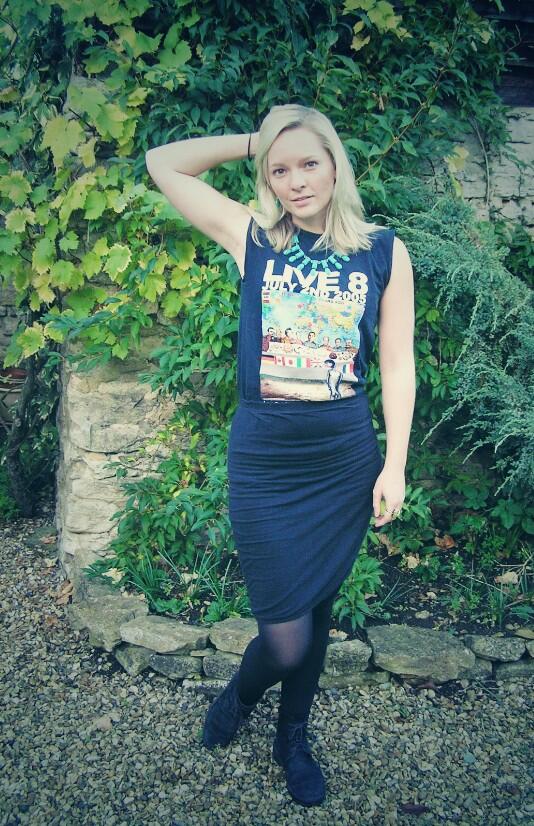
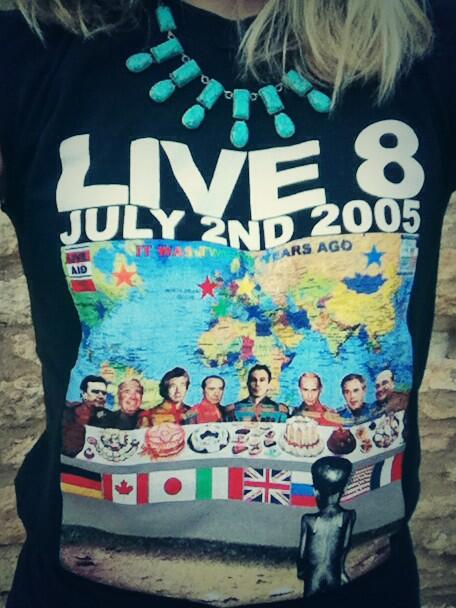
In this picture, I'm wearing a top and a pair of boots both bought from Oxfam. Buying from Oxfam not only promotes the reduction of consumption and waste in the fashion industry but also gives to an incredibly good cause. Oxfam is committed to reducing poverty around the globe and promoting human rights. This top is actually originally from Edun- an ethical fashion brand which uses Fair Trade in its supply chain and promotes use of the African fashion industry. Fair Trade strictly promotes human rights in its labour policies. 

The skirt is from People Tree- pioneer of ethical and Fair Trade fashion and the first fashion brand to be accredited by the WFTO. People Tree is committed to providing long term jobs to those who need them most and creating beautiful items of clothing in the most human and environmentally friendly way possible.

By choosing to shop from ethical, Fair Trade, second hand and charity fashion brands; we can make a positive difference to peoples lives around the world and throughout the supply chain. Our purchasing power should not be over looked. As consumers we hold immense power over fashion brands; their supply meets our demand- if we demand better, they will have to provide.


Join the debate on twitter : )
@onegreendress  |  @MrsWandas  |  @BlogActionDay12  |  #BAD2013  |  #HumanRights

Blog Action Day: Rana Plaza

The Rana Plaza factory collapse in Bangladesh opened up the worlds eyes to a problem that has been ignored for too long. The garment industry has been employing labourers around the world without being fully aware of how human rights are being enforced or simply disregarded. This is mainly due to fashion brands out-sourcing labour and refusing to own the factories that produce their garments. In the past, this has relinquished them from any responsibility for factory safety upkeep and working conditions but now people are starting to question this chain of accountability. 


The fashion industry's supply chain is notoriously long and complicated; spanning many countries and cultures, travelling thousands of miles, passing through countless pairs of hands. This is where the problem of accountability and responsibility arises. Who do we look to, to enforce human rights throughout the supply chain? 

Fashion brands? Consumers? Governments?

Well I think that we all need to chip in. When a person's human rights are denied, we have a collective responsibility to speak up. Governments around the world should all be moving towards introducing not only minimum wages but living wages. There are some fashion brands that are already providing this for their employees around the world and I hope to see others follow in this vain. As consumers, what can we do? Well, we can demand more. We can call out the retailers that are disregarding human rights, we can promote the ones that are enforcing them and we can cast our vote with our money by letting our purchasing power do the talking.

After the Rana Plaza disaster, the 'Accord on Fire and Building Safety in Bangladesh' was drafted by Uni Global Union, IndustriALL and NGWF. It was put forward to all the fashion companies producing garments in the city. Under the accord, garment workers can refuse to work in unsafe conditions and must continue to be paid under these circumstances until the issues are resolved. The fashion brands were not eager to sign, with some major hesitations from; Matalan, Edinburgh Woolen Mill, J D Sports and River Island. We are still waiting for Peacocks and Sports Direct to sign.

The fashion companies complicit in the Rana Plaza disaster were invited to Geneva to discuss setting up a fund for the victims. Of the 29 companies involved, only 9 turned up and only Primark contributed to the fund. It's time for us to call upon these fashion brands to become accountable to their workers. You can call on Peacocks and Sports Direct to sign the Accord via the See Through Fashion campaign here. You can also chose to cast your consumer vote wisely by shopping for clothes using ethical fashion brands that enforce living wages and by buying second hand from charity and vintage shops.


Learn more about human rights and ethical fashion by following the debate today on twitter
#humanrights | #BAD2013 | #ethicalfashion | @blogactionday12 | @MsWandas | @onegreendress


Picture from: Business of Fashion

Thursday, 3 October 2013

Balance Diversity: Ethics on the Runway

On this blog I constantly find myself discussing ethics during the manufacturing process of fashion but the ethical credentials of the fashion industry cannot be limited to this one area. Last month Naomi Campbell, Bethann Hardison and Iman brought attention to the fashion industry's limited use of black models on the catwalk. The 'Diversity Coalition' penned an open letter to the heads of the four main Fashion Councils: London, New York, Paris and Milan.


Their message is clear, ethnic diversity on the catwalks is disturbingly limited. And it's not just on the runway- Vogue has been repeatedly criticised for hiring almost exclusively white women for its covers, not only in the early days but in disturbingly recent years too. 

When we discuss ethical fashion, we shouldn't be demanding fair treatment for only those people who manufacture our clothes; we should be demanding fair treatment for all people hired in the fashion industry including those closer to home. Let me know whether you think we need more ethnic diversity on the runways in the comments section below or tweet me #BalanceDiversity

Tuesday, 17 September 2013

Green Carpet Challenge and Net-a-Porter Capsule Collection

Today a very exciting ethical fashion collaboration launches online. The fabulous ethical fashion front-runner, Livia Firth, has teamed up with Net-a-Porter to launch an exclusive capsule collection of ethical fashion garments designed by five of the most talented British designers to date. Designing two pieces each for the collection are Victoria Beckham, Christopher Kane, Roland Mouret, Erdem and Christopher Bailey.


Each piece in the collection is created to the standards set by the GCC ethical criteria and 20% of the proceeds will be donated to (RED) which supports the elimination of mother-to-child transmission of HIV.

Once again Livia Firth is breaking down barriers in the fashion industry. Livia has managed to succeed in the near impossible task of bringing together five top British designers and creating a collection of beautiful fashion pieces that are ethical and sustainable. The pieces in the collection are all stunning but my favourites are worn in the pictures below. The pieces are all ultra-glamorous and designed to be worn on the red carpet which results in hefty price tags; but it's Livia's mission to prove to the world that ethical fashion can most definitely be high fashion- and boy has she succeeded...


Top: Christopher Kane, Middle: Victoria Beckham, Bottom: Livia Firth wearing and with Erdem Moralioglu

In the ethical fashion debate it is often discussed about where change should come from. Should it come from the consumers, the fashion houses, the people with the money or politicians? In this venture, Livia Firth demonstrates that it can (must? should?) start from the high fashion designers and from the A-listers on the red carpet. This way, as with the rest of fashion, it can trickle down to the mainstream as consumers and designers are inspired by higher end fashion. The influence that celebrities and high fashion houses have on the world of fashion is immense and what Livia is trying to achieve, if she can pull it off, could have immeasurable impact on the future of ethical fashion. So far, so good! We can't wait to see what Livia has in store for us next : )

Pictures acquired from Vogue, Net-a-Porter and Eco Age

Thursday, 14 March 2013

Reading into Ethical Fashion

Want to find out more about ethical fashion? Enjoy a good book? Then look no further! I have written a blog post for the Oxfam Fashion Blog about my favourite ethical fashion reads. Click here to check them out : )


Friday, 8 March 2013

A Few Articles That Have Caught My Eye

I've stumbled upon a few articles and blog posts recently (some not quite so recently) that have related to some of my previous posts here on One Green Dress and I thought that I would pass them your way to peruse at your leisure. Do take a look- they are all well worth reading:


'The Sustainable Fashion Paradox' by threadGently


This very well written piece talks a little more about the high street ethical lines, for example H&M's Conscious Collection, (see my article on the collection here) and discusses whether sustainability and fast fashion are compatible or mutually exclusive. It's an age old question that is found at the crux of the ethical fashion industry: Sustainability VS Consumerism.

'Luxury Leather and the Amazon' by Lucy Siegle


This article written for The Observer discusses Gucci's New Jackie O Bag that is sourced from deforestation free-zones. The bag is in collaboration with Livia Firth and Lucy Siegle's Green Carpet Challenge project where designer brands dress celebrities ethically at Red Carpet events to raise awareness for ethical fashion. The article explains a bit more about the difficulties of ethics in the leather industry but I am yet to find out whether the Gucci bag tackles the problem of leather tanning in an ethical manner- TBC...

'Why I Prefer Real Leather' by The Conscience Collective


Another article on ethical leather which gives a reasoned and down to earth opinion on the leather debate. It's a subject which I find really interesting mainly because people always focus on Fur as opposed to leather (you can see my blog post on the subject here). Hopefully articles like this one and the new Gucci handbag will get people talking about it more.

Monday, 4 March 2013

Made in Britain vs Fair Trade


I've been doing some research for a study recently and it has involved conducting interviews on the subject of the garment industry. I've had lots of interesting points coming up which I'm sure I will be discussing with you in the coming weeks but I thought I would start with this one. 

In the industry of sustainable fashion- what is more sustainable: Made in Britain or Fair Trade? The question isn't really about adding up the stats to get an exact answer, I was just interested to know what you think? Here are a few points on both that seem to come up a lot:


Made in Britain


  • Less Travel

    • Not having to import goods from countries far away saves considerable costs on transport. It also uses much less energy especially in air miles which can considerably contribute to your carbon footprint. Sustainability is intrinsic to ethical fashion and looking after the environment is a huge part of this.

  • UK Labour Laws

    •  There seems to be less concern about accountability if garments are made in the UK. It's commonly assumed that it's more likely in the UK that the supply chain will heed to labour laws and give workers better working conditions on a more frequent basis than in Fair Trade where slip ups are expected to occur. 

  • Support UK's Economy

    •  During our current recession, every extra job in the UK is seen as a benefit and a boost to the UK economy. Supporting UK jobs is part of supporting our family, friends and the wider community of Britain to pull itself out of economic decline.


Fair Trade


  • Fair Wage and Conditions

    • The Fair Trade standard sets an example for how wages and working conditions should look in developing countries. This is especially important to you and me because it is Western societies like the UK that take advantage of the lack of human rights and unions and exploit workers in developing countries for cheap labour.

  • Support a Developing Economy

    • Fair Trade is set up to give the poorest people better jobs and better wages because they need it most. Giving someone who is on the brink of poverty a job that pays properly means the difference between staying alive and actually living. It's the difference between a job and a livelihood. Fair Trade is more than bread on the table, it gives oppurtunites to grow, improve and invest in a future.

  • Support the Fair Trade Movement

    • Even if Fair Trade haven't got it completely right yet, people have told me that they want to support the movement by buying the products anyway. The idea behind Fair Trade is a very good one and it is a not-for-profit registered UK charity. Fair Trade is how all trade should be.


I'm not trying to say that buying British Made products and Fair Trade products are mutually exclusive; I think they work well side by side and benefits can be reaped by purchasing and supporting both of them. Both are considered ethical fashion in my books but I would love to know which one you think is more important. Are there more benefits I have missed from either that you would like to bring to the table? Let me know : )

Saturday, 2 February 2013

H&M Conscious Collection: Is it really ethical?


I remember when I first heard about H&M's Conscious Collection a couple of years back when it was just a fledgling line testing the waters. I specifically remember trying to decide whether or not I approved. It just reminded me of seeing the Fair Trade label starting to appear on Cadbury and Nestle chocolate bars- it just didn't feel right. Then I saw the Fair Trade label appearing on white tank tops in Tesco and that felt even less right. I suppose it's a trust issue- I just couldn't seem to equate a multinational corporation with the local values that ethical and Fair Trade fashion represent.


Before Christmas we saw whole hosts of activists 'fainting' outside H&M stores in a campaign to draw attention to the poor working conditions of labourers used in H&M's supply chain.

 "Last year, over 2400 workers passed out in Cambodian factories due to malnutrition as a direct consequence of low salaries. But H&M, one of Cambodia's main buyers, continues to refuse to pay a living wage to its workers,” 

says Jeroen Merk of the International Clean Clothes Campaign. H&M claim that as they do not own the workshops that create their clothes (they only place orders with them) they have no responsibility for them. If we look at H&M's website and sustainability report, they claim to be not only environmentally but socially ethical.


According to 'Labour Behind the Label', H&M "Accepts the principle of a living wage, but applies legal minimum/industry benchmark". They grade H&M level 1 on a scale of 0-5 measuring how well a company is doing in the task of aliviating poverty wages in its supply chain. To see Labour Behind the Labels's company profile for H&M and more detail on why they were awarded their grade, click here. The grading was given after a survey completed in the summer of 2011; so have H&M improved since then? A documentary was released in Sweden  explaining how H&M is not tackling social ethics in their supply chain in October 2012. To view the documentary, click here.


The documentary includes interview clips with H&M's CEO as well as their Head of Sustainability. These clips make for very interesting viewing as they highlight how uncomfortable these questions on the living wage make the high profile employees. According to the documentary, labour costs account for only 1-3% of a garments price so I struggle to understand why the living wage is not at the forefront of H&M's vision of sustainable fashion. 

Maybe it's that H&M is just focusing on environmental issues? The Ethical Consumer has awarded H&M's Organic collection 7.5/20 and H&M's regular line 6.5/20 using categories of research including Animals, Environment, People, Politics and Sustainability. So when focusing on ethics as a wider issue than just living wages, H&M scores much higher, though clearly still not anywhere near 'ethical' fashion levels. 


This tally's up with my thoughts on H&M's Conscious Collection- the line boasts of its organic cotton, tencel and recycled polyester which really focus's on H&M's commitment to environmentally ethical fashion. The launch of the collection will coincide with H&M's Conscious garment collection initiative which allows customers to bring in bags of unwanted clothing to be swapped for H&M vouchers. These unwanted garments will then be recycled. This initiative brings recycling to the forefront of the consumers mind- it encourages us all to think about recycling and our environmental impact a bit more when we shop.


It's this exposure to ethical awareness which really makes me want to find the good in H&M. Their Conscious Collection may not be 100% socially or environmentally ethical just yet, maybe not even 50%, but at least they are putting something out there. The bulk of fashionistas that walk in and out of H&M probably won't even be aware that there is such a thing as ethical fashion, because lets face it, it is still a niche, growing market. The fact that when they walk in mid-March to see this 'ethical' line has launched, it might make them question the ethical values of the rest of H&M's collection. It might encourage them to start to think about where their clothes come from.

And for those of us who are more aware of the impact of the garment industry, even though we can see that H&M isn't a forerunner in ethical fashion, if we buy their Conscious Collection, high sales and a larger demand might encourage the company to think about expanding the Conscious Collection values to the rest of their lines. Also, previews of this years collection are pretty darn fabulous so right now I think I'm leaning towards the pro-Conscious Collection team...but it's so tricky I'm just not sure. It's not expected to launch until March 25th so we have time to make up our minds. Clearly the H&M debate does not have a definitive answer, and there's so much more information on the subject out there, so I would really love to know what you all think and where you all stand. Comment below to let me know!  : )


Links and articles related to the Conscious Collection:

Lucy Siegle 'Is H&M the new home of ethical fashion?' April 2012

Sarah Karmali 'Vanessa Paradis Named Face Of H&M Conscious Collection' January 2013

Labour Behind the Label- Articles with 'H&M' tag

H&M- About- Sustainabilty

Cold Facts Documentary about H&M

H&M under fire as Swedish television unearths Cambodian production scandal

H&M: Workers left homeless and unpaid after factory closes